Create a 15-second cinematic 16:9 Japanese dojo sword-duel video from the reference storyboard: start with a slow pull-back from the woman's intense blue eyes, then a slow pull-back from the Japanese male warrior's eyes; both stare ready to attack, then appear far apart in a minimalist dojo, slowly approach, raise katanas, clash in an elegant readable duel, the woman in yellow gains control, the man surrenders and drops his sword, then the woman calmly lowers her katana; no text, no grid, no dialogue, no extra characters.
Create a 15-second cinematic 16:9 Japanese dojo sword-duel video from the reference storyboard: start with a slow pull-back from the woman’s intense blue eyes, then a slow pull-back from the Japanese male warrior’s eyes; both stare ready to attack, then appear far apart in a minimalist dojo, slowly approach, raise katanas, clash in an elegant readable duel, the woman in yellow gains control, the man surrenders and drops his sword, then the woman calmly lowers her katana; no text, no grid, no dialogue, no extra characters.
15-second, no-dialogue, fully immersive high-speed brutal fight short film.
Two characters @ image1 and @ image2 .
Live-action realistic style. Close-quarters, high-speed chaotic melee combat with no rules, fully out-of-control brawling. No flashy choreography—pure raw. Continuous exchange of punches, kicks, blocks, body checks, throws, and grappling entanglements. Ultra-realistic impact. Exaggerated yet physically grounded motion speed. Entire sequence in 120 FPS with no slow motion. Rapid dashes, evasions, and high-speed limb swings. Extreme motion blur and speed trails amplify intensity while preserving realistic weight and physics.
Master-level cinematic camera movement:
A professional film camera stays tightly locked to the action, flying dynamically with the fighters—high-speed dives, sudden stops, whip pans, and full 360° orbital tracking. The camera moves in sync with punches, kicks, and evasions, with responsive shake and displacement. One continuous take, no cuts. Sharp push-pull tracking, sudden directional shifts, fully integrated into the fight for a face-to-face immersive combat perspective. Smooth, zero-latency motion.
Master-level precision editing:
0–3 seconds: ultra-fast cuts to enter combat.
3–10 seconds: seamless action continuity with zero stutter or breaks.
10–15 seconds: dense, violent rapid-cut climax.
Editing rhythm escalates with combat intensity. Fast intercutting enhances chaos. Precise beat timing, no redundant shots. Constant suffocating high-speed pacing.
Environment Setting
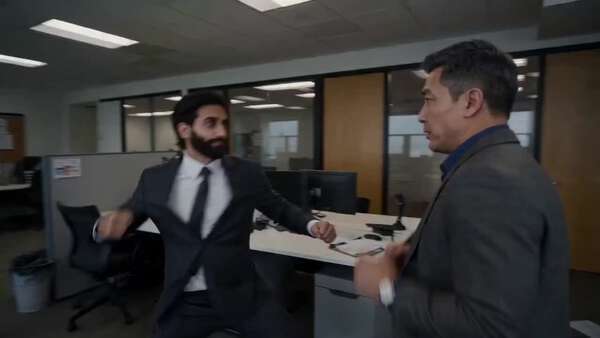
Modern open-plan office with desks, computers, cabinets, printers, and swivel chairs; realistic layout with cool overhead lighting and side backlight for strong contrast. Slightly cramped space for added tension; no glass-breaking.
Environmental Interaction & Constraints:
Combat affects the space only through natural, physically justified collisions—papers scatter from air movement (not attacks), chairs slide or topple on impact, desks shift slightly without deliberate damage, and screens remain intact with minor vibration. No unnecessary or intentional destruction of equipment.
Body-driven combat: grappling, pinning, counter-throws, and realistic slams with subtle impact cracks/vibrations. Natural airflow—light paper/dust movement only, no exaggeration.
Final Action Design
Final 2–3s: both throw simultaneous close-range punches, freezing inches before impact—fully tensed, heavy breathing, locked in perfect deadlock.
SUBJECT
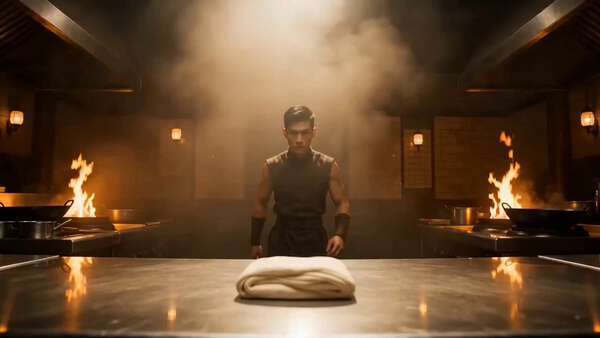
A lean, martial-arts–trained chef with sharp facial structure and closely cropped hair. His wardrobe blends a contemporary Chinese chef uniform with kung-fu training gear: a sleeveless fitted top with a mandarin collar in dark matte fabric that catches light subtly, forearms wrapped with cloth bands for grip and control, loose tapered trousers allowing deep stances, and soft kitchen shoes suited for silent movement.
His body proportions emphasize long limbs and flexible wrists; elbows deliver explosive strikes. Every action follows a deliberate combat rhythm—brief stillness, sudden acceleration, then a locked finish—supported by grounded stances and fast pivoting footwork.
ENVIRONMENT
A traditional Chinese open-flame cooking station.
An iron wok rests permanently on the burner. A polished metal counter reflects the warm lighting. A blue-and-white porcelain bowl sits centered in the foreground.
Lighting combines warm overhead illumination with strong flickering firelight from the stove. Thin oil smoke drifts through the air while heat shimmer subtly distorts the background.
MOOD
Focused intensity. Movements feel disciplined, aggressive, and precise—closer to a martial performance than casual cooking. Nothing chaotic; every motion feels intentional and controlled.
TIMELINE
0:00–0:02
Extreme close-up from a wide POV. The chef stands behind the counter, which remains between him and the camera. He steps forward, compresses his posture, then sharply lifts his head and locks eyes with the lens.
Both hands grip a mass of dough. With one clean pull he stretches it outward, folds it once, then pulls again. The dough begins separating into a small set of evenly forming strands.
0:02–0:05
Cut with slight handheld energy. The chef keeps the noodle bundle under full control between both hands. Through smooth fold → align → stretch movements he extends the strands into clean parallel lines.
Roughly 8–12 thin noodles arc outward and sweep close past the lens. He completes the final stretch and lays the aligned noodle bundle neatly onto the counter.
0:05–0:07
Camera shifts with a brief recoil before stabilizing. The chef glides sideways behind the counter. One palm sweeps across the surface, sending shrimp and greens into the air and directly into the waiting wok.
The wok never leaves the stove; he grips only the handle. Any stray ingredient is intercepted and redirected smoothly into the pan.
0:07–0:10
Single continuous shot. The chef manipulates the wok entirely through wrist control and momentum. No hands enter the pan.
He lifts, tilts, and snaps the wok so the ingredients rise, spin, and land back inside. His elbow strikes the stove edge—sparks scatter briefly. He presses the wok down into the flame, then pulls upward, drawing the fire into a second controlled flare.
0:10–0:12
Match-movement tracking shot. Still gripping the wok handle, he pivots his stance. With his free hand he retrieves the noodle bundle from the counter and drops it into the wok in one clean motion.
He immediately resumes tossing: three crisp cycles—fast → faster → sudden stop. Shrimp, greens, and noodles visibly combine while sauce coats everything evenly.
0:12–0:15
Cut to a steady POV. Total stillness. The chef tilts the wok and slides the finished dish into the porcelain bowl—revealing glossy noodles, plump shrimp, and vibrant greens.
He lifts the bowl toward the camera until it fills the frame. One finger taps the rim, creating a faint vibration. Steam rises quickly and expands until it completely fogs the lens, ending in a soft fade.
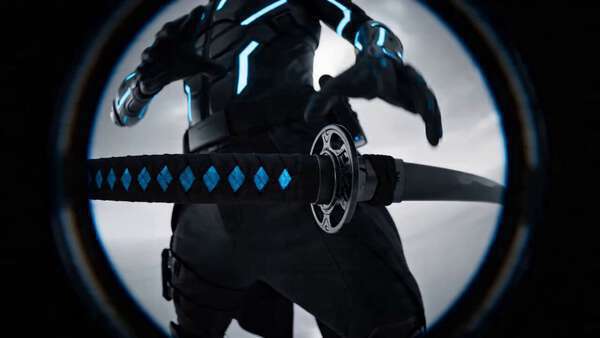
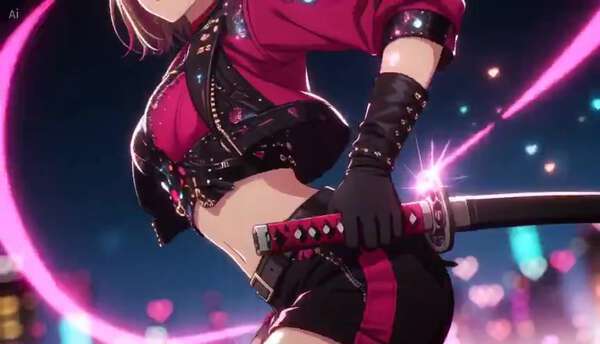
Extreme close-up from low angle. The torso twists away from the draw side — the left shoulder drops forward, the right shoulder pulls back, weight loading into the rear hip. Magenta energy arcs swirl around the torso, building intensity. A bright flash ignites at the sword hilt.The body uncoils — explosive rush directly toward the camera with heavy motion blur and diagonal speed streaks. The face fills the frame for one instant, eyes locked forward — then the drawn blade sweeps past in a magenta flash and the figure is already behind the camera, shrinking to a distant silhouette against the dark horizon.The sky erupts with criss-crossing sword flash lines — each slash cuts diagonally across the full width of the sky, intersecting other slashes at random angles. Each line appears as a thick bright beam — white-blue core with magenta edges — then gradually thins and fades to a thin pink trace. New lines continuously appear while older ones dissipate. The layered effect builds to peak density before slowly subsiding.The camera rushes forward to catch up. A glowing blade trail sweeps across the lens. The figure stands in noto posture — right hand raised above the left shoulder holding the sword at a diagonal, left hand at waist level guiding the blade toward the scabbard opening.The blade gleams with a bright star-burst sparkle at its midpoint. Inch by inch over several seconds, the right hand lowers — the glowing sword descends in a slow, deliberate arc toward the waiting left hand. The gleam intensifies at the point where blade meets scabbard.The instant the blade seats — a massive magenta-white explosion of light detonates from behind. Radial beams shoot outward in every direction. The figure becomes a pure silhouette against the overwhelming brightness.Within the light burst, the kanji 斬 materializes in bold calligraphic brushstrokes — dark ink against the blinding glow. Ink-splash drip effects trail from the base of each stroke. A bright horizontal magenta beam slices through the center of the kanji, and the character fragments along the cut line — upper strokes drift upward, lower strokes drift downward, as if space itself has been bisected. The magenta glow gradually dims. The fractured kanji holds its split position as the light fades to a twilight afterglow.
 Seedance 2.0