A colossal storm god towering above a coastal megacity, roughly 800 meters tall, body composed of living storm matter — swirling thundercloud musculature, veins of blinding lightning branching through translucent vapor skin, eyes glowing with the pale blue core of a hurricane. Vast cyclonic halos rotate slowly around his shoulders like atmospheric rings — hook at second two: he raises one hand toward the sky and the entire cloud layer above the city begins rotating in response.

The atmosphere itself becomes a weaponized climate engine.

Pressure drops instantly across the metropolitan basin.

Storm systems accelerate as the god’s gesture pulls moisture, wind, and electrical charge into a single supercell directly over the skyline.

The destruction unfolds as a layered climate catastrophe: hurricane-force winds rip glass from skyscrapers, tornado funnels descend between towers, and lightning chains strike power grids across multiple districts simultaneously.

Rainfall intensifies beyond natural limits — entire streets flood within seconds as drainage systems fail.

Each movement of the storm god reconfigures the weather architecture.

When he steps forward, a pressure wave spreads outward through the city, flipping vehicles and collapsing cranes.

The gauntlet moves through the financial district progressively overwhelmed by climate violence: street level where floodwater surges through subway entrances → mid-rise buildings shredded by horizontal wind shear → rooftop battles as communication towers become lightning rods.

Helicopters spiral out of control in the turbulent air.

Entire glass towers implode as microbursts hammer their upper floors.

Chase-cam through the urban canyon while hurricane winds form rotating debris vortexes between skyscrapers.

Velocity ramp at the moment the storm god slams both hands downward — triggering a simultaneous lightning storm across the entire grid while three tornado funnels merge into a single massive vortex that tears through downtown.

Cut to aerial: the megacity now sits inside a rotating superstorm visible from the stratosphere.

Floodwater forms new inland rivers while the skyline burns under continuous lightning strikes.

The storm god stands at the eye of the cyclone, calm inside the atmospheric engine he has created.

Diegetic illumination from branching lightning across storm clouds and glass fragments, volumetric rain sheets and wind-driven debris fields, cinematic hurricane turbulence simulation, ultra-detailed water and atmospheric physics, 4K.
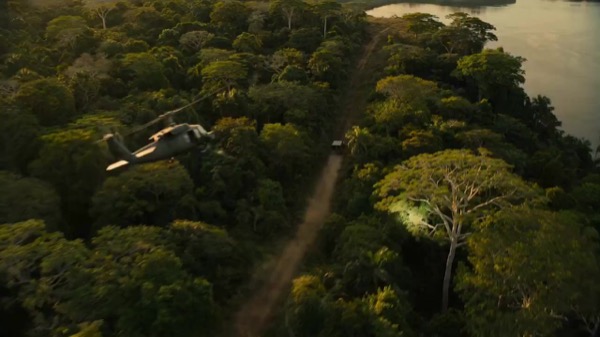
Bird's-eye aerial view — military helicopter hunts jeep through dense jungle canopy. Jeep launches off cliff into river — camera pulls back revealing full scale. Quick cut to underwater POV. Dusk, golden-green light. Shot on 65mm lens, cinematic.
@YouArtStudio
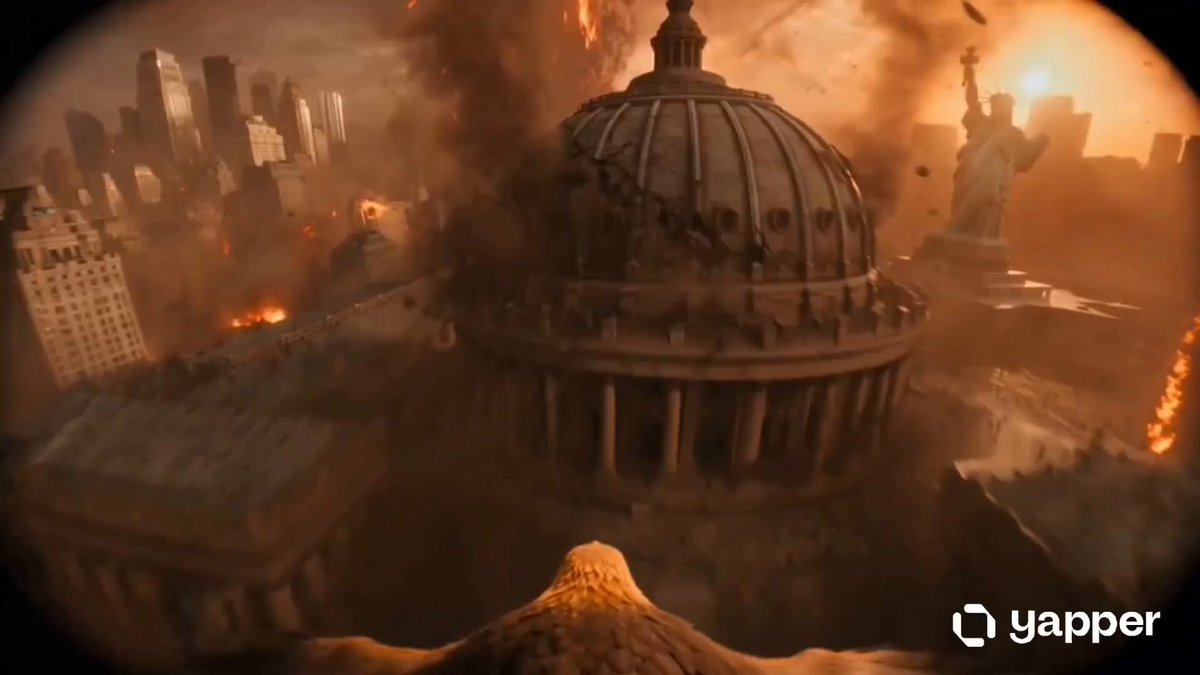
A full, uncut first-person POV simulating an adult golden eagle escaping at extreme speed.
Camera style: ultra-wide distorted lens with intense edge stretching, an exaggerated sense of spatial depth and motion parallax, and a cinematic macro-like pressure effect. The camera surges forward at near-supersonic speed with violent whipping shakes, rapid dives, aggressive rolls, and chaotic aerial turbulence driven by powerful wing flaps.
The scene is set in an ancient version of New York during a catastrophic volcanic super-eruption. The skyline is reimagined as towering stone skyscrapers, primitive suspension bridges, and colossal monolithic structures. Volcanic ash storms rage as lava bombs rain from the sky, obliterating everything in their path.
The golden eagle dives at extreme speed through a massive stone archway resembling an ancient Manhattan gateway; flaming debris and collapsing towers explode outward as molten fragments strike. It spirals downward between towering structures, narrowly dodging falling stone slabs and fiery wreckage, skimming just above the ground before bursting through a collapsing avenue.
It then races through a grand, ancient Wall Street district, where colossal columns and statue-lined pathways shatter under volcanic shockwaves. Massive stone pillars snap and topple like dominoes, marble fragments scattering violently as the eagle performs sharp, chained evasive maneuvers between collapsing structures.
Next, it plunges vertically through a giant domed temple inspired by early New York architecture. The dome cracks under immense pressure, huge chunks crashing down as the eagle weaves through tight interior spaces and escapes through a ruptured wall.
The flight continues toward an ancient monumental complex resembling a primitive Statue of Liberty structure, now partially destroyed by lava impacts. The eagle darts through shattered frameworks and collapsing stone scaffolding, weaving in tight S-shaped paths through falling debris.
The camera remains violently unstable throughout, constantly shaken by shockwaves and turbulence. The atmosphere is dominated by a blood-orange volcanic sky, glowing lava trails streaking across the frame, and towering bursts of firelight. Ash, molten fragments, stone dust, and burning embers swirl chaotically around the camera.
Emotional tone: extreme, relentless, and adrenaline-surging, capturing a desperate high-speed escape through the destruction of an ancient New York.
15-second continuous single-shot action sequence.
No cuts. No scene transitions.
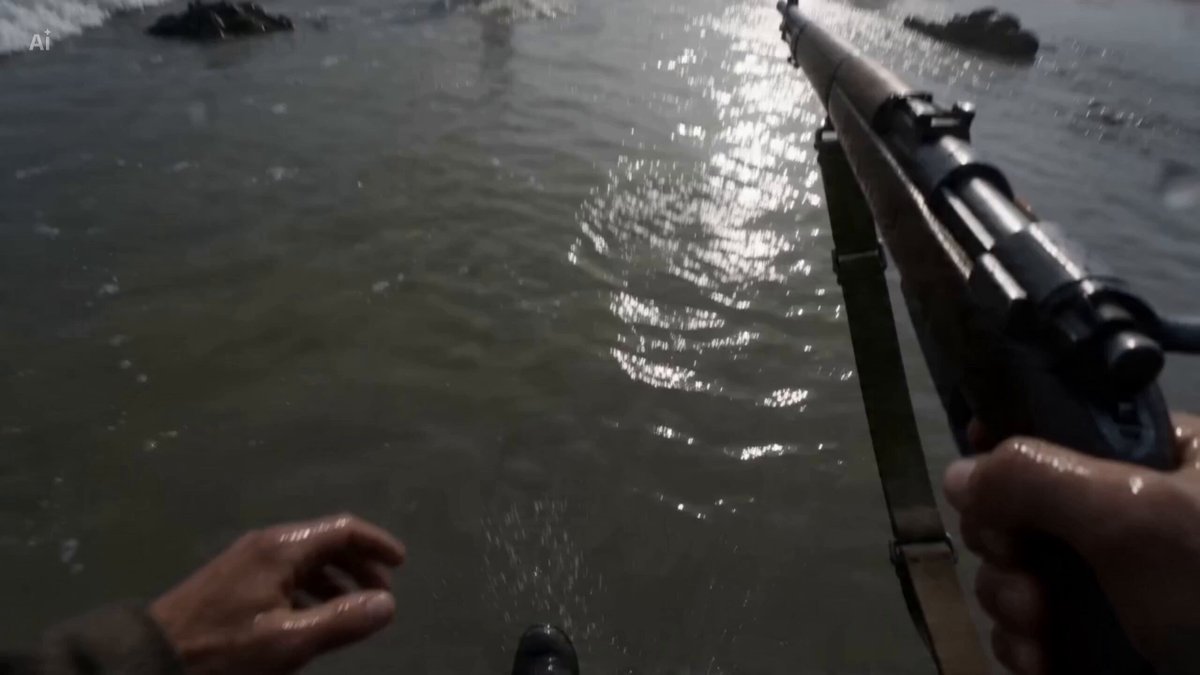
Cinematic war realism, handheld POV camera, desaturated colors, heavy grain, harsh daylight through smoke, water droplets on lens, mud and debris, realistic physics, chaotic but readable motion
Extreme immersion, grounded soldier movement, controlled disorientation, no stylized action
Scene:
WWII beach landing, shallow water, incoming waves, heavy smoke, distant bunkers firing, explosions across shoreline
0–3s — arrival (impact into chaos)
POV from a soldier jumping into shallow water.
Camera drops abruptly:
– water splashes across lens
– breathing heavy
– vision unstable
Immediate gunfire hitting water nearby.
3–6s — disorientation
Camera rises unevenly.
Running forward through water.
– bullets impacting around
– soldiers falling in peripheral vision
– explosions sending sand and water upward
Camera shakes but keeps forward direction.
6–10s — push forward
Transition from water to wet sand.
Soldier stumbling, regaining balance.
Nearby cover (metal obstacle or debris).
Quick crouch.
Hands briefly visible steadying weapon.
10–12s — slow motion shock
Explosion nearby.
Time slows:
– sand and debris suspended
– shockwave rippling
– sound implied muted
Camera slightly tilts.
12–15s — survival instinct
Time snaps back.
Soldier rises and pushes forward again toward cover.
Gunfire continues.
Camera lurches forward with urgency.
Frame holds mid-run.
Freeze.
 Seedance 2.0