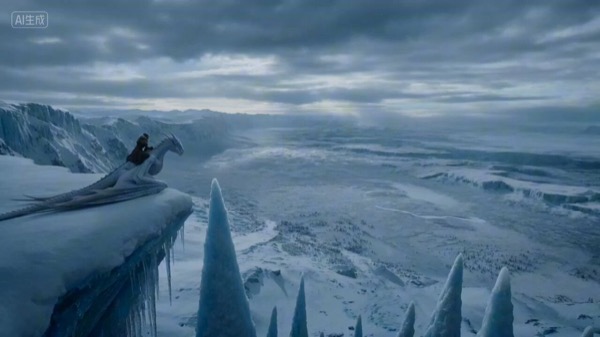
An adventurer launches her pale ice creature from a frozen cliff's edge — the creature diving over a vast icy expanse as snowflakes scatter.
Camera positioned along the cliff captures the creature dropping before extending its wings. The rider leans forward as the creature spirals down between towering ice formations.
Below: armored behemoths march across the frozen terrain.
The creature releases a chilling blast while climbing sharply upward, frost spreading beneath.
Frozen canyon flight, aerial maneuver, icy landscape, cinematic lighting, 4K.
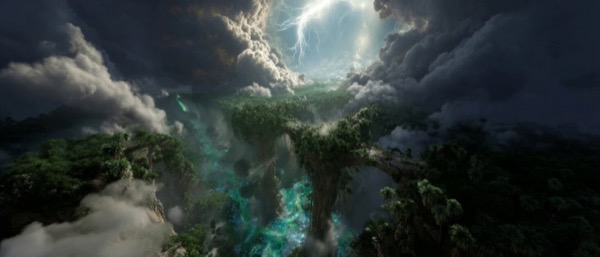
A close-up shot follows a (@ element) ship flies and flapping dynamically through a colossal landscape with giant arches, clouds, and storms, with crystal-clear water below.
The feet (@ element) of a giant appear, attempting to crush the ship. The ship dodges them, splashing water from the crystal-clear water .
The flying ship quickly disappears over the horizon. Fast-paced action cinematic scene.
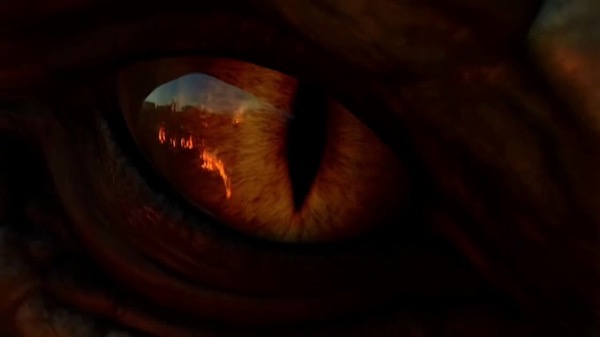
The scene opens in extreme close-up on a dragon’s eye reflecting a burning city. The camera pulls back rapidly, revealing the creature perched atop a crumbling tower. Without warning, it leaps. The camera dives with it in chaotic handheld freefall, fire erupting from its jaws. Mid-air, the camera swings underneath the dragon in a smooth orbit as wings beat violently, debris spiraling downward. A rapid 180-degree roll transitions into a dynamic chase shot through collapsing spires.
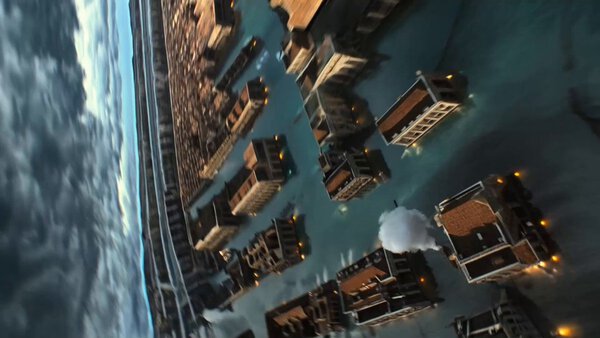
Prompt : Aquatic jet-skimmer over flooded ruins with steam squalls (single continuous shot) Open high in the sky with a fast circling aerial orbit: flooded ruins stretch below, half-submerged colonnades, rooftops like islands, canals gleaming, and a low storm ceiling dragging rain across the water. A high-speed jet-skimmer (needle hull, brushed alloy, teal pulse lights) rockets along a canal corridor like a blade, throwing a razor-thin rooster tail that peels into spirals while steam squalls rise where warm vents meet rain-chilled water. The camera maintains a rapid orbit while dropping altitude, continuously shifting distance in one fluid move: wide orbit for scale, then a violent swoop closer, then back out, each pass revealing a different angle as the skimmer rides centimeters above the surface, hydro-foils kissing the water, spray turning to mist in the humid air.On a tight pass, snap into a steep top-down lock for a beat, tracking the skimmer like a guided camera drone, then whip the orbit lower into a fast diagonal chase skimming above wavelets and broken masonry edges. Slingshot ahead for a brief head-on shot as the skimmer screams toward camera, pressure rippling the canal into V-shaped shock waves, then whip around into a close side chase where the hull slices the rain and spray detonates in clean sheets. Dive even tighter to the rear jet nozzles: droplets hammer into beads, debris taps and tumbles, mist boils into a tunnel, and the orbit compresses into a near-skimmer spiral, fast and relentless.A floating market raft cluster drifts far in the distance; sudden decision: the pilot cuts off-line through a narrow gap between two submerged archways, a sharp lateral slide with a burst of thrust, then snaps back into the canal with a precise, aggressive correction. The camera spears through the spray tunnel in the skimmer's wake, then rockets upward into the final, fastest orbit: climb hard and spiral out to an epic reveal as the storm tears open and a towering sun shaft drops onto the flooded city like a spotlight, the skimmer a teal dart below with steam squalls and wake curls shimmering in the light.
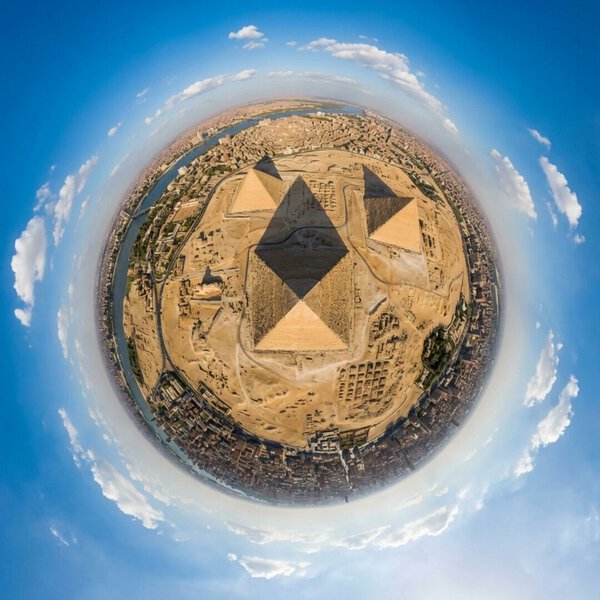
Do this for Egypt: <instruction>
1. Analyze Input Variable:
Input A is a specific Architectural Landmark and its surrounding City (e.g., The Pyramids/Cairo, The Eiffel Tower/Paris, The Shard/London).
Analyze the subject to determine:
The Pole: The tallest or most geometric central point.
The Texture: The urban grid vs. the natural terrain (e.g., desert sand vs. concrete blocks).
The Horizon: The specific sky and cloud conditions of the region.
2. Container
Goal: A "Tiny Planet" 360-degree panorama.
Composition: A perfect circular world centered in a square frame.
Projection: Stereographic Projection (Little Prince effect). The terrain is warped into a sphere where the ground is in the center and the sky is the perimeter.
Perspective: Nadir View. The camera is positioned directly above the central landmark looking straight down, causing the landmark to appear as the "North Pole" of the planet.
3. Topography
Epicenter: Input A’s primary landmark sits dead-center. Its geometry (triangle, spire, or dome) points directly at the camera.
Sprawl: The surrounding city or environment radiates outward from the center.
Constraint: Buildings near the center point inward; buildings near the edge of the circle point "upward" toward the clouds, creating a radial array of architecture.
The Transition: A clear distinction between the ancient/monumental center and the modern/natural sprawl surrounding it.
4. Syntax
The Edge: A ring of vibrant blue sky and scattered white cumulus clouds frames the entire circular landmass.
The Horizon: The very edge of the circle is where the ground meets the sky in a 360 degree loop.
5. Lighting & Atmosphere:
Lighting: Low Angle Directional Sunlight. A strong light source from one side (e.g., the 3 o'clock position) casting long, dramatic shadows across the planet surface to emphasize 3D volume.
Detail: High-resolution aerial photography aesthetic. Visible street-level detail (roads, tiny cars) warped by the curve.
Output: ONE image, 1:1 Aspect Ratio, "360 Camera" aesthetic, high texture and sharp focus.
</instruction>
 Seedance 2.0